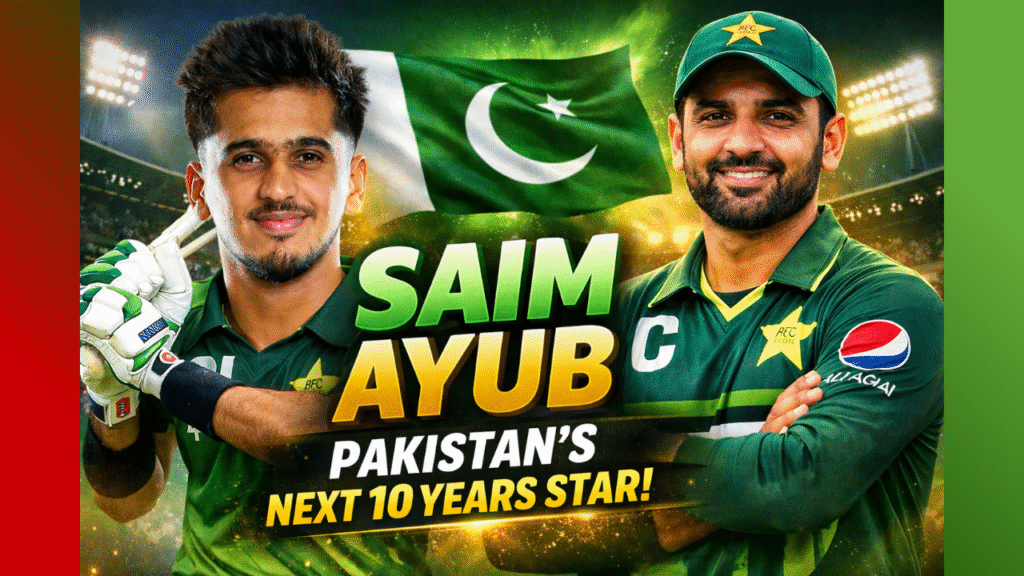
Pakistan cricket has been through ups and downs in recent years — from fluctuating batting performances to captaincy changes, and intense debates over team balance. Amid all this, T20I captain Salman Ali Agha has publicly backed a promising talent for the long haul: Saim Ayub. According to recent cricket news, Salman believes this young opener has both talent and growth potential that could serve Pakistan cricket for the next ten years. (Batting with Bimal)
This article explores the context, statistics, and future possibilities for Pakistan cricket, focusing on what Salman Ali Agha said and why this endorsement matters right now.
Who Is Saim Ayub? The Emerging Pakistan Opener
Saim Ayub burst onto the international scene with a combination of elegant strokeplay and aggressive intent at the top of the order. Born in Karachi, he has already displayed flashes of brilliance across formats. (Batting with Bimal)
In a recent Pakistan T20I series against South Africa, he scored 108 runs in three matches, including an unbeaten 71, boasting a strike rate of 150. In the corresponding ODI leg, Ayub scored 169 runs in three games with two fifties at an impressive average. (Batting with Bimal)
These numbers are strong signals from a 23-year-old whose role is to give Pakistan momentum early in the innings — especially critical in modern white-ball cricket where teams need quick starts. Despite some inconsistent outings, Salman Ali Agha’s belief in him underscores his long-term value. (Batting with Bimal)
Salman Ali Agha’s Leadership & Vision
Salman’s own career reflects resilience and adaptability. Agha has been a versatile middle-order batsman across formats, and his leadership roles — particularly as Pakistan’s T20I captain — have positioned him as a key voice in shaping team culture and future direction. (Grokipedia)
His endorsement of Saim Ayub is more than friendly praise — it’s a public vote of confidence that Pakistan should invest in young talent and give consistent opportunities to budding stars. His exact words were:
“Saim is someone who can play for the next ten years and become the player we all want him to be.” (Batting with Bimal)
This is significant in a cricketing culture where selections and expectations often shift with form and public opinion.
Why This Matters for Pakistan’s White-Ball Future
1. Balancing Aggression and Stability
Pakistan’s batting has struggled with consistency at times, especially in T20 cricket. While players like Babar Azam and Fakhar Zaman brought world-class performances, recent series showed that Pakistan’s powerplay momentum and middle overs performances were not always ideal. (Dawn)
By investing in an aggressive young opener like Saim Ayub, Pakistan can tap into modern scoring demands — high strike rate, positive intent, and adaptability — traits essential in T20 and ODI cricket today.
2. Bridging Youth and Experience
Salman’s belief signals a strategic blend of youth and experience in the Pakistan setup. Ayub’s youthfulness, paired with leadership support from experienced players, could accelerate his development and reduce pressure that often stifles young talent.
This blend is central to sustaining Pakistan’s performance in global events like the T20 World Cup and Champions Trophy — where performance under pressure and tactical depth are keys to success.
Performance Snapshot: Recent Form & Stats
Some of Ayub’s recent performances:
- T20I vs South Africa: 108 runs, RSR ~150 (Batting with Bimal)
- ODI vs South Africa: 169 runs, two fifties (Batting with Bimal)
- T20 Tri-Series (SL & ZIM): 118 runs at SR 114.56 (Batting with Bimal)
- Bangladesh Premier League: 68 runs (four games) (Batting with Bimal)
This tells us a few things:
- Ayub can switch formats.
- He’s shown explosive starts and tempo control when needed.
- Still learning to handle inconsistency — but growth potential is clear. (Batting with Bimal)
Salman Ali Agha: More than a Captain — A Mentor?
Salman Ali Agha’s role extends beyond captaincy. His own cricket journey is a template for persistence. According to performance archives, his contributions in ODIs and Tests reflect adaptability, sometimes anchoring innings when others fall. (Grokipedia)
That he speaks on Ayub’s prospects suggests strategic thinking — not just in match-to-match tactics but in squad building. Young players supported by seasoned leaders often develop better cricketing maturity.
Analysis: What Pakistan Gets from Saim Ayub Long Term
A 10-year commitment is rare in international sport — but here’s why it makes sense:
1. Modern batting demands: T20s and ODIs require top-order run engines. A player like Ayub, if harnessed correctly, becomes a core resource.
2. Time to evolve: Consistency comes with experience. Giving a player sustained exposure often yields higher performance ceilings.
3. Squad balance: Pakistan’s pipeline looks more competitive when blended with youth, leading to better bench strength.
From a talent development lens, this aligns with global cricket trends where teams nurture young openers early — e.g., Jos Buttler (ENG), Shubman Gill (IND), or Travis Head (AUS). Their careers took off with trust and consistent runs at the top.
Challenges Ahead: Consistency & Adaptation
Even with Salman’s backing, Ayub must prove himself over time. The Pakistan setup is known for its passionate fanbase, and expectations can bias selections prematurely.
Critics will point to:
- Inconsistent outings in domestic leagues
- Need for better performance against top bowling attacks
- Technique adaptation for varied pitches
But cricket history shows that long-term backing often correlates with eventual success — provided the player evolves. Analysts stress that consistency beats flair at the international level.
Conclusion: A New Era for Pakistan Batting?
Salman Ali Agha’s bold faith in Saim Ayub is not just motivational — it’s strategic. Pakistan cricket today faces:
✔ Need for solid openers
✔ Demand for high scoring rates
✔ Growing pressure in global tournaments
Ayub’s talent, if harnessed with consistency, could redefine Pakistan’s top order for years. Pakistan fans want excitement and run machines, and Ayub embodies that risk-reward blend.
In Salman’s words, “he still has room to grow, but he has what it takes to become the player we all want him to be.” (Batting with Bimal)
What this means: Pakistan isn’t just thinking about the next series — it’s planning its batting future with vision and intent. That could be game-changing in world cricket.

